Nepal landslide disaster: What triggered the cataclysm that killed hundreds (VIDEOS, PHOTOS)
A massive flash flood has killed at least 360 people across Nepal and China's Tibet after a torrent of water, mud and debris tore through the Himalayan border region on Wednesday, sweeping away villages, roads, bridges, and power facilities.
Nepal Police said Thursday afternoon that 359 bodies have been recovered, while Chinese authorities have confirmed another three deaths at Gyirong Port in Tibet. Thousands remain missing on both sides of the border.
‘Thousands of families missing’
“Town after town has been wiped out within hours,” Nepali Foreign Minister Shisir Khanal told India’s NDTV on Thursday morning. “Thousands of families have lost homes and are missing as of now. We are still trying to ascertain the full extent of the disaster.”
Khanal said around 500 foreigners, mostly pilgrims on the Kailash-Mansarovar route, are out of contact. These include about 300 Indians reported missing.
Nepal’s Department of Tourism said that among the missing are 47 Americans, 34 Australians, 33 Britons, 24 Canadians, and 19 Malaysians, as well as citizens of more than 20 other countries. Four Russians are also among those unaccounted for.
Beijing said 558 people were missing in the flash flood, including 260 foreign nationals, in Tibet’s Gyirong County.
❗️ More Horrifying Footage Shows Gigantic Mudslide Engulfing China’s Gyirong Region - WARNING: Distressing 📹
— RT_India (@RT_India_news) August 26, 2026
‘Major casualties’ are feared after infrastructure was completely obliterated in the major border crossing between China and Nepal. (Xinhua) https://t.co/lct3g9fOIcpic.twitter.com/M1NzVj0Naq
Nepalese officials have stressed that being out of contact does not necessarily mean the travelers were caught in the flood, as roads, electricity and communications have been wiped out across parts of the mountainous region. Many were pilgrims traveling toward Mount Kailash in Tibet, while Nepali trekkers were heading toward Gosaikunda Lake ahead of the Janai Purnima festival.
Flood’s fury caught on camera
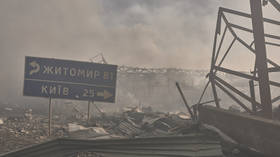
Videos show the flood’s fury as it swept aside everything that stood in its way, including hydropower projects, bridges, roads and houses. Buildings were swallowed by muddy water and vehicles tossed through the debris as residents fled with little warning.
⚠️ Extremely Distressing Footage Shows Mudslide Sweeping Up Fleeing Citizens, Cars, & Buildings On China-Nepal Border
— RT_India (@RT_India_news) August 26, 2026
Viewer discretion.
📹 @mcudirectorhttps://t.co/RV9HxrYyP4pic.twitter.com/pFtKSs5v42
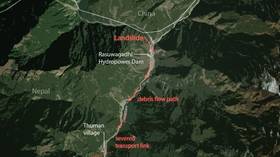
Floodwaters surged through the Bhote Koshi River at around 9am local time, causing widespread destruction in the Syapru Besi and Timure areas of Rasuwa district before racing downstream into the Trishuli River.
❗Nepal Floods: At Least 7 Dead, Security Personnel Missing 🇳🇵
— RT_India (@RT_India_news) August 26, 2026
The worst-hit areas include Timure and Syabrubesi in Rasuwa, where floodwaters have swept away homes, bridges and parts of a key road towards the China border, according to The Kathmandu Post.
Nine Armed Police… https://t.co/OGz6YNAMPxpic.twitter.com/XRGgZGxHj7
The speed of the surge was extraordinary. The Kathmandu-based International Centre for Integrated Mountain Development (ICIMOD) said the Trishuli rose by as much as nine meters in just 30 minutes at one monitoring station, while another recorded a seven-meter rise over roughly the same period.
Apocalyptic view of the flash flood that struck northern Nepal and Tibet today.
— Massimo (@Rainmaker1973) August 26, 2026
A bridge collapsing under the fury of the water. pic.twitter.com/YdHjZ2SwPQ
Authorities have warned people along riverbanks in Rasuwa, Nuwakot, Dhading, Gorkha and Chitwan to remain on higher ground. Several flood-monitoring stations were themselves damaged or swept away.
Infrastructure wiped out
At least 19 motorable bridges and nearly 40km of roads have been swept away, cutting off communities and crippling access to the worst-hit areas.
A sudden massive flood swept through northern Nepal this morning, causing extensive damage in Timure and Syafrubesi areas of Rasuwa district after the Bhote Koshi River surged around 9 am, reportedly from the direction of Tibet.
— All India Radio News (@airnewsalerts) August 26, 2026
Nepal Army, Armed Police Force and Nepal Police… pic.twitter.com/P78X3328dX
Nepal’s electricity network also took a major hit. Eleven hydropower projects and one solar facility were affected, knocking 431.1MW of generating capacity off the national grid. Transmission lines and substations were damaged, while electricity was completely cut in Rasuwa and disrupted in several neighboring districts.
Trishuli Bazaar After The Floods 🇳🇵
— RT_India (@RT_India_news) August 26, 2026
The river has redrawn the landscape.
Drone footage shows entire rows of riverside homes gone, leaving behind a barren expanse of mud, debris and scattered structures.
📹 Social Media https://t.co/RV9HxrYyP4pic.twitter.com/0rToqQpbPU
Rescue operations have been complicated by destroyed roads, deep mud, high water and difficult Himalayan terrain. Nepal has mobilized the army, police and helicopters, while at least 28 police officers are themselves among those still missing.
What triggered the disaster?
Initial reports pointed to an earthquake, but the US Geological Survey later said the seismic event was actually a massive glacial collapse and debris flow that caused catastrophic impacts downstream. ICIMOD believes an ice-rock avalanche crashed into the Lhende Khola and may have temporarily blocked the river before unleashing the devastating surge, although the precise sequence remains under investigation.
The flash flooding along the Lhende Khola and Bhotekoshi Rivers near the Nepal,China border was triggered by a cascade of geological events:
— Cio (@LoveLigth7) August 26, 2026
Ice-Rock Avalanche:
A massive ice-rock avalanche detached from a glacier high on the Himalayan slopes.
Landslide Dam Creation:
The… pic.twitter.com/E7QluW7K5L
The danger may not be over. ICIMOD has warned that a blockage remains lodged upstream, posing a threat of another sudden flood, with evacuation orders issued around Gyirong Port.
Authorities in Nepal report villages washed away by a massive flash flood in a region bordering Tibet. Roads, bridges, and power projects were damaged across the Himalayan area. pic.twitter.com/LUquf3vWNP
— Open Source Intel (@Osint613) August 26, 2026
The Lhende Khola has now flooded twice in just 14 months. The same border region was hit by another devastating flash flood last August, when a glacial lake in Tibet overflowed and nine people were killed.
China races to find missing
Chinese authorities said three people were killed and 558 remained missing in Tibet’s Gyirong County as of Thursday morning, more than doubling the previous tally of 265. Chinese state broadcaster CCTV said 260 of those unaccounted for are foreign nationals.
Two people have been rescued alive, according to Chinese state media, as hundreds of emergency workers, troops and rescue specialists continue searching the devastated border area.
The torrent devastated the border crossing, burying buildings in debris and washing out sections of road. Xinhua reported that rescuers initially struggled to reach the core disaster zone as raging water, rain and completely destroyed roadbeds blocked access.
China has dispatched 111 emergency rescuers to the mudslide-stricken Gyirong Port in China's Xizang, carrying detection, life-saving, demolition, communication, and support equipment.
— Li Zexin 李泽欣 (@XH_Lee23) August 27, 2026
The plane has now landed at Dingri Airport in Shigatse. pic.twitter.com/NxfkffAwxO
President Xi Jinping ordered rescuers to make every possible effort to find the missing, evacuate those at risk and prevent secondary disasters. Tibet activated its highest Level-I natural-disaster response, while Beijing launched a national Level-II emergency response and sent hundreds of firefighters, troops, engineers and other rescue personnel to the region.
Beijing reinforced the operation early Thursday by dispatching an additional 111-member China Rescue Team with detection, communications and lifesaving equipment. A PLA Y-20 military transport aircraft was also sent to Tibet carrying a Western Theater Command team to coordinate joint rescue operations.
China has also allocated 120 million yuan ($16.8 million) in central disaster-relief funds and another 100 million yuan for emergency infrastructure restoration.
New Delhi launches emergency response
Nepal has asked both India and China for help with rescue operations. The Bhote Koshi feeds into the Trishuli River, which eventually flows into India as the Gandak, prompting authorities downstream to closely monitor rising water levels.
India has put vulnerable areas in Bihar and Uttar Pradesh on alert and begun sending emergency assistance to Nepal. An Indian Air Force C-130J carrying around 10 tonnes of shelters, blankets, hygiene kits, solar lamps and medicines departed for Kathmandu on Wednesday night.
The shipment followed a phone call between Indian Prime Minister Narendra Modi and his Nepalese counterpart Balendra Shah, during which Modi offered “all possible humanitarian assistance.” India said additional transport aircraft and helicopters were being prepared for relief and evacuation operations.